
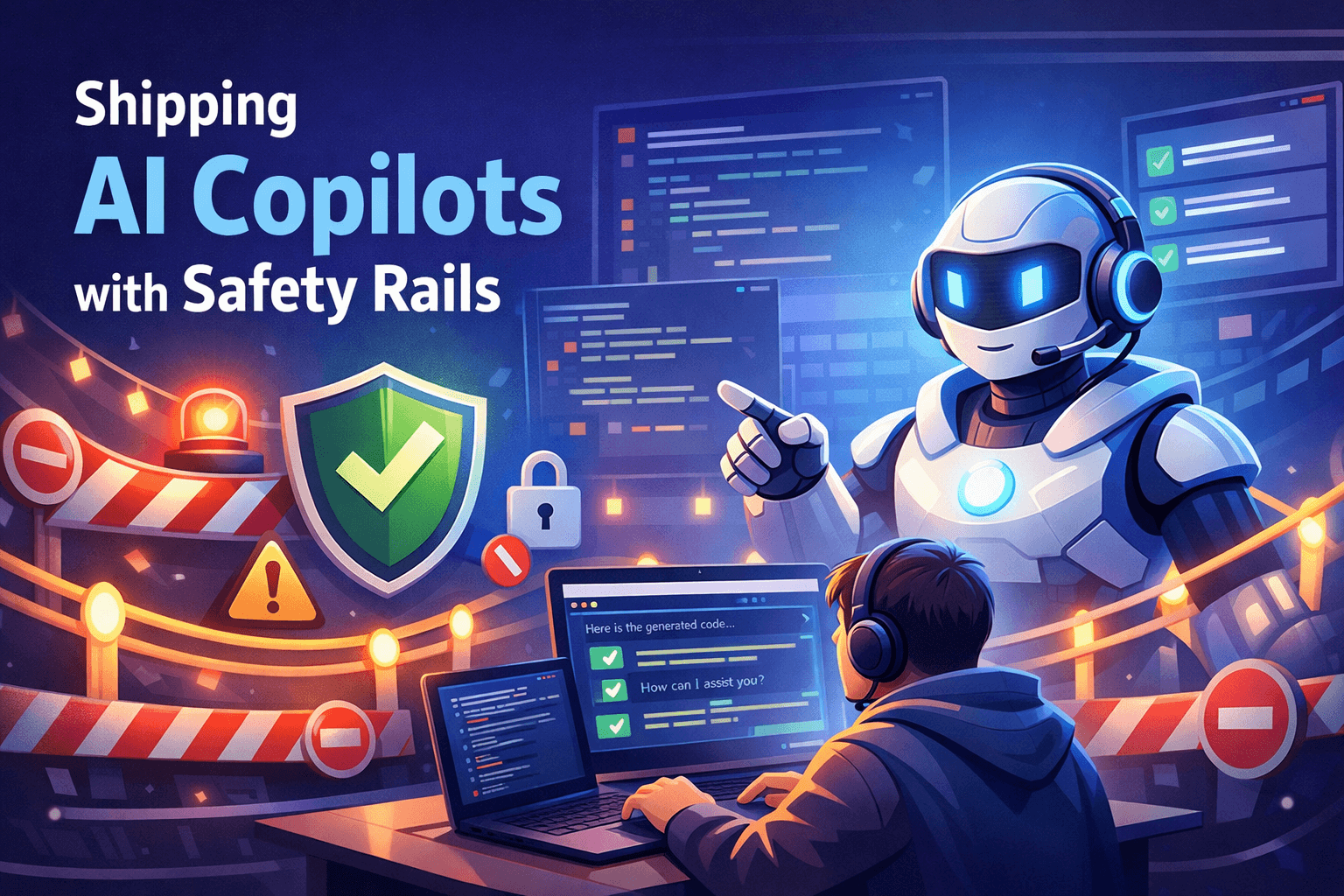
Guardrails live closest to the user intent
We keep every copilot flow observable by default. Prompts are versioned, evals run on golden sets nightly, and we ship chat transcripts with redaction and policy outcomes so product and security see the same truth.
type Escalation = { owner: string; reason: string };

const approveToolCall = definePolicy<Escalation>({
  id: "pii-blocker",
  onViolation: ({ tool, input, reasons }) => ({
    owner: "trust-and-safety@ndi.studio",
    reason:       "PII caught before calling " + tool + " => " + JSON.stringify(reasons) + "",
  }),
});

const result = await guardedAgent.run({
  prompt,
  tools: [crmSearch, createTicket],
  policies: [approveToolCall],
});

if (!result.allowed) audit.log(result.violation);
What ships with every copilot
- Offline eval harness with regressions tracked per prompt version
- Streaming traces + heatmaps so latency budgets stay honest
- Fallback UX that keeps agents quiet when confidence drops
“The difference was the safety telemetry—we could show legal exactly where guardrails triggered before launch.”
Director of Product, fintech client
Architecture sketch
Treat the copilot like a pipeline: intent → policy → plan → tools → answer. Observability wraps every hop with traces and redaction to keep legal and ops in the same loop.
Debug checklist
- Trace spans for tool calls with input/output masking
- Golden set pass rate by prompt version
- Fallback success rate when policy blocks execution
Launch criteria
Evals ≥ 0.86 accuracy on golden set, P95 latency < 1.2s, policy hit rate < 6%, and CSAT ≥ 4.4/5 in pilot.
Architecture sketch
Treat the copilot like a pipeline: intent → policy → plan → tools → answer. Observability wraps every hop with traces and redaction to keep legal and ops in the same loop.
Debug checklist
- Trace spans for tool calls with input/output masking
- Golden set pass rate by prompt version
- Fallback success rate when policy blocks execution
Key takeaways
- Guardrails before launch
- Evals on every prompt
- Human-in-the-loop defaults